
Moving Day: The Generous, Guilt-Free Magic of New York Trash
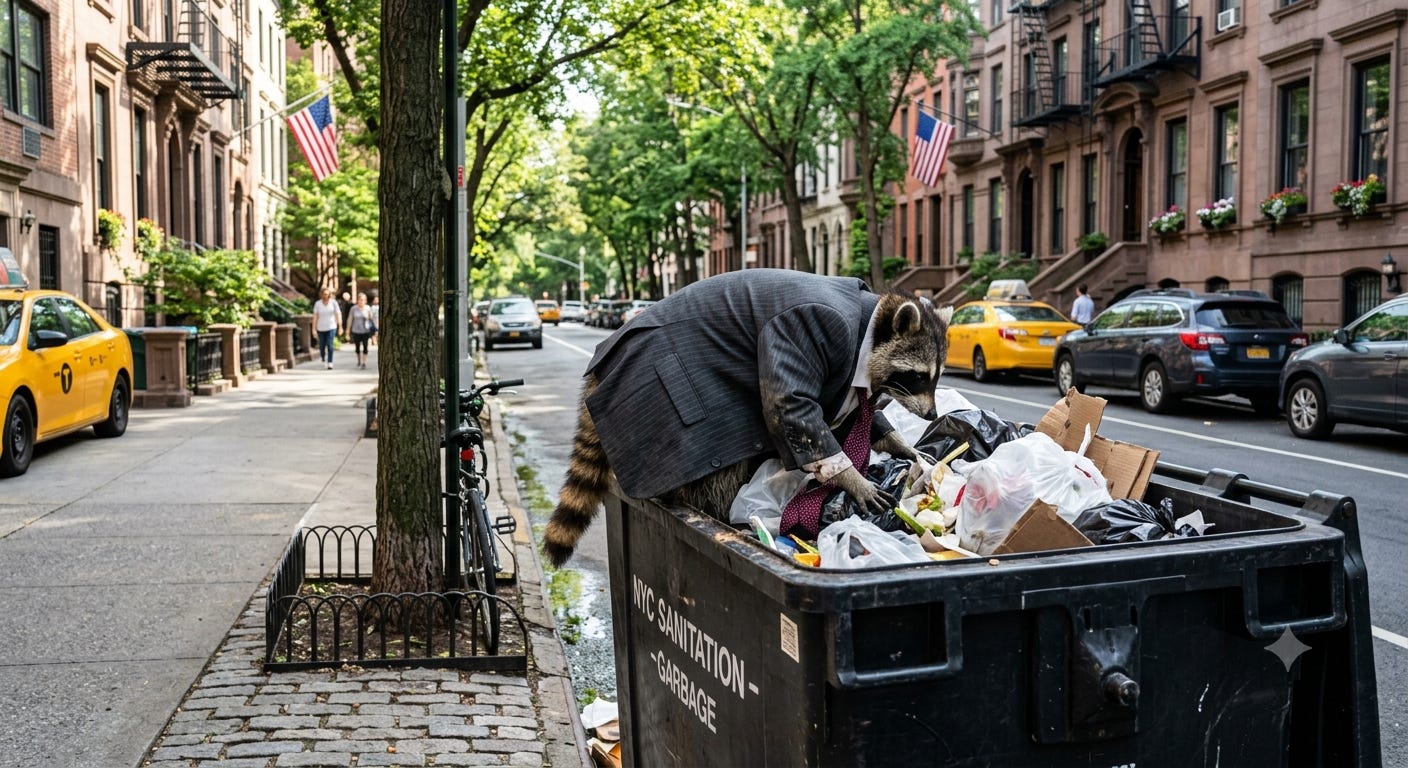
On Trash Pandas and Dumpster Diving

If you want to understand the true soul of New York City, don’t look at the skyscrapers, the luxury co-ops, or the Michelin-starred menus. Look at the sidewalks on the last night of the month—especially in the summer.
From the outside, New Yorkers look rude, mean, and antagonistic. We walk fast, we glare, and we don’t do small talk. But that’s just the surface. Underneath the gruff exterior, this city is deeply, uniquely generous. We are the people who will aggressively yell accurate directions at a lost tourist, give you an unsolicited five-star restaurant recommendation on a subway platform, and leave our best belongings out on the curb for you to take.
The end of the month in New York is a sacred, chaotic ritual of that generosity. It’s Moving Day. Because space is our most precious commodity, we have to get rid of things just as fast as new things come in. My wife and I do it in the summer while the kids are away at camp.
It certainly isn’t a display of wasted potential; it’s a masterclass in the magnetic draw of the new.
The Neighborhood Rhythm of Letting Go
Indeed, the sidewalks transform into an open-air museum of letting go. You can actually map the life cycles of a neighborhood just by watching what hits the pavement. In fact, the most active chat at my children’s school isn’t about homework or grades—it’s the local Buy Nothing Project network.
What might look weird is actually a wonderful, hyper-local ecosystem of paying it forward. If you watch it closely, you can intuit exactly what is happening behind the brick facades:
You see who is quietly getting ready to move apartments.
You see who has finally let go of their youngest child’s plastic toys.
You see whose baby is out of diapers, and who just traded one workout hobby for the next.
As a real estate agent running a brokerage firm in Manhattan, I watch this firsthand every day—both when it works and when it doesn’t.
Years ago, I read Marie Kondo’s The Life-Changing Magic of Tidying Up and realized something profound about how we pass things on. When you give hand-me-downs to your family or your siblings, the transaction is often loaded with guilt. Maybe you don’t actually want that sweater or those Fletch-style pants, but you can’t say no to family. So you accept them, stuff them in the back of your closet grumbling all the way, and only dare to get rid of them years later.
But when New Yorkers leave things on the street or post them to a neighborhood group, there is no guilt on the receiving end. People are completely intentional about what they decide to grab. They jump only when it’s something they truly want.
Life Re-Worn, And Re-Sanded
Losing someone forces an entirely different kind of letting go. My mother and our family lost my stepfather Joe about six months ago, and it soon looked like a trunk sale from a Madison Avenue boutique. Unlike the kicker in the classic ‘80s movie Fletch, when the bad guy targeted Chevy Chase’s character for murder because they were the exact same height, weight and body type, my mother zoomed in on me because Joe happened to be a total clothes horse—and everything fit me.
The steady stream coming from his closet to mine, curated by my discerning mother, has done two things. First, it has given me a lot of new, colorful clothes to wear (with a non-zero amount also destined for Goodwill). But more importantly, it has given me a way of remembering him daily. Every time I button up one of his shirts, he’s there.
That same spirit of reinvention is why I occasionally jump on a good street find myself.
A few years ago, I walked past a pile and spotted a snare drum left out on the curb. I brought it home for my son, who used that single, rescued drum to find his rhythm. Today, he plays a full, real drum set.
Then there was the weathered piece of furniture I found right on my own block. I hauled it inside, sanded it down, and gave it a sleek coat of black lacquer (I took it back behind my building for the smelly part, to be fair). Today, that exact piece serves as a beautiful entry table in my real estate business, acting as a functional staple in my listing staging inventory to help new buyers envision their own future homes.
Even the literary world overflows onto the pavement. I have a famous neighbor who constantly leaves stacks of books on the stoop of his brownstone—new volumes must arrive through his mail slot just as fast as he tries to purge the old ones.
Old Tin, Pressed back into Service
While I’ve always trusted this instinct, one particular dumpster dive felt miraculous.
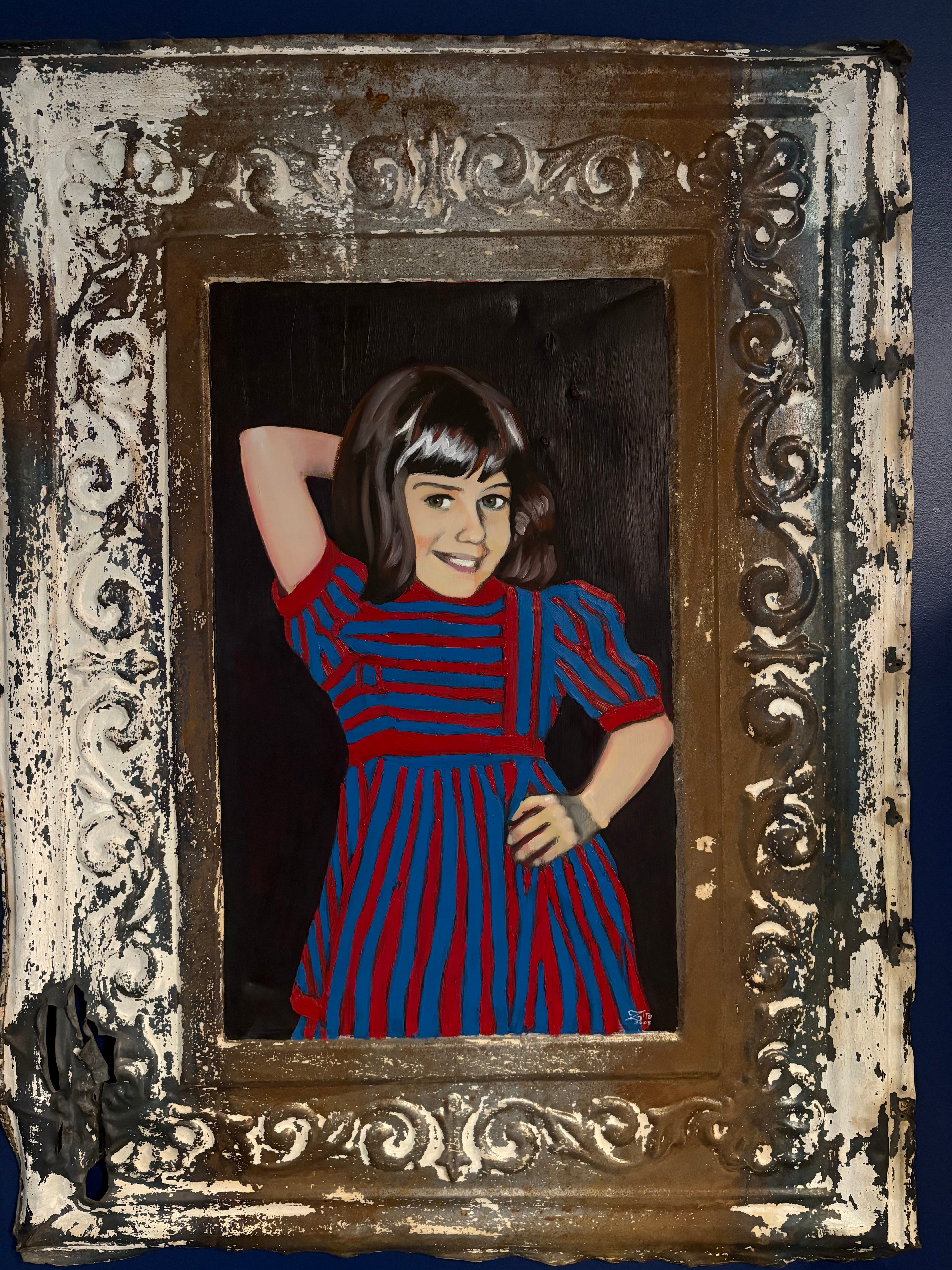
Years ago, when I was newly engaged, I was walking from my apartment in Tribeca to the Lower East Side to tour a wedding venue. Before I even left my neighborhood, I spotted a beautiful, delightfully shabby-chic piece of pressed tin leaning right against a street dumpster. It had been cut from a ceiling during a loft demolition—a relic of the late 1800s covered in flaking white paint, looking exactly like an ornate picture frame.
I picked it up, wrapped it in a clear plastic bag from a nearby Broadway luggage shop to protect my skin, and carried it straight through Chinatown. On Orchard Street, that piece of street trash led me straight to the red storefront of an art gallery run by local street-portrait artist Antony Zito.
I left the tin with him, and a month later, he transformed it into a stunning oil portrait of my fiancée based on a childhood photo. What started as literal garbage ended up as a priceless engagement gift hanging permanently on our wall.
The Magic is In Your Face
The real difference in New York is that, unlike anywhere else, this culture of shedding and reclaiming is completely in your face.
It’s not tucked away at the end of some long, suburban driveway. It’s right there on the asphalt, endless and unavoidable. And when you bend down to grab something from a stoop, you will occasionally catch a glint in a passing stranger’s eye. It isn’t judgment—not in a bad way. It’s a look that says, “Ooh, that’s so cool.”
It is a silent, shared acknowledgment between New Yorkers that something magical has just happened. A piece of the city’s past has just found its future.
The Ultimate Truth of NYC Trash:
New York is an unbelievably wealthy city—not just because of Wall Street or billionaire real estate, but because its abundance overflows directly onto the asphalt. It is a place of such profound excess and constant reinvention that its trash is richer than most cities’ treasure.
The next time you find yourself walking the city streets at the end of the month, slow down. Look at the dumpsters and the stoops. Don’t fight that inner urge to look closer. You might just find a piece of New York history that changes your son’s life, stages your next listing, or ends up framed on your wall.
What’s the best thing you’ve ever rescued from a New York sidewalk or a Buy Nothing group? Let me know in the comments below.
About the Author
When he is not rescuing a piece of discarded architectural history from a Tribeca sidewalk dumpster, Scott Harris is busy helping people navigate the wildest transitions of their lives.
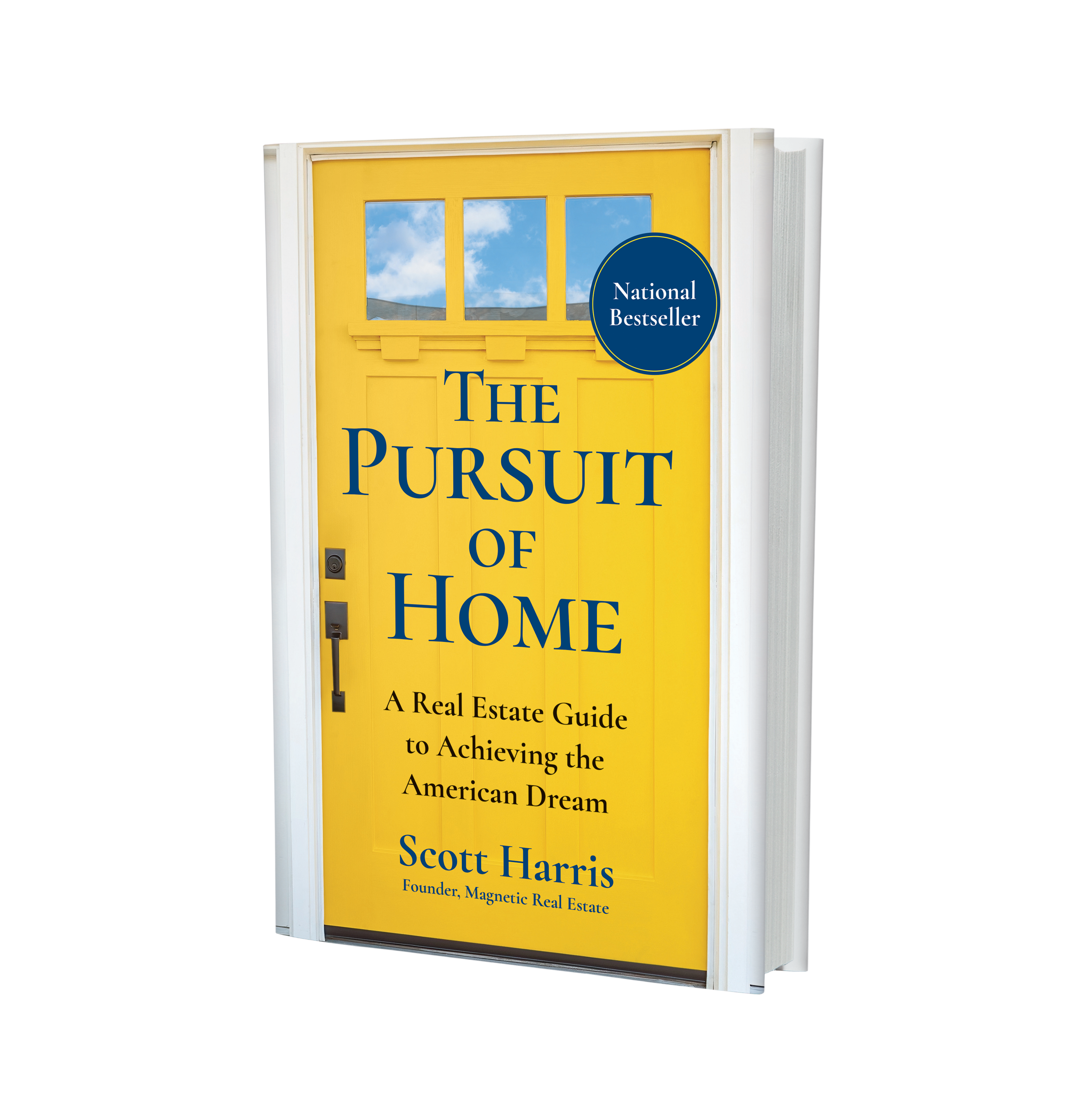
He is the founder of MAGNETIC, an independent firm dedicated to making big dreams come true through real estate, and the author of the step-by-step real estate roadmap, The Pursuit of Home.
Over a twenty-year career closing nearly two billion dollars in residential sales, Scott has operated as equal parts strategic advisor, business coach, and property therapist—a unique skillset that comes in exceptionally handy whether he is decoding the hidden character of a neighborhood, helping clients look past the concrete of a bad deal, or discovering why a weathered street-side table belongs in a luxury home staging inventory.
He lives in Manhattan with his wife and children, where he remains a card-carrying, stubborn believer in the permanent possibility of a perfect summer afternoon, the guilt-free magic of neighborhood hand-me-downs, and real estate miracles.